
Method Qualification and Validation: Mastering the Analytical Procedure Lifecycle
Method qualification and validation are not the same. Here's the real difference and how to handle both correctly.


Executive Summary
In pharmaceutical development, few distinctions are as significant practically and regulatorily as the one between method qualification and method validation. Yet, these terms are often misused, resulting in wasted resources, delayed submissions, and unnecessary audit findings. This guide provides a clear, expert perspective rooted in the latest ICH Q2(R2) and Q14 guidelines, both adopted in November 2023, along with FDA expectations and real-world implementation experience. The aim is not just to define the terms but to offer a practical framework that helps organizations make the right decisions at the right time, effectively carry development knowledge forward, and stay prepared for inspections throughout the analytical lifecycle.
The Real Cost of Confusion
Many organizations either over-validate early-stage methods, wasting time and resources on work that isn't necessary yet, or under-qualify them, which can lead to significant regulatory risks when the method finally reaches GMP use. Both errors are frequent and costly. Over-validation causes delays in development schedules, while under-qualification can result in validation failures, repeated studies, and challenging discussions during inspections.
The main cause is almost always the same: viewing qualification and validation as interchangeable instead of as two separate, connected activities within the analytical procedure lifecycle. ICH Q14, adopted alongside Q2(R2) in November 2023, was specifically created to address this by promoting the use of development data in validation. Organizations that continue to overlook this connection are missing out on significant efficiency gains.
Clear Definitions
Method Qualification
Method qualification is a documented, risk-oriented evaluation conducted during early development to verify that an analytical procedure can produce reliable data for its current intended use. It is intentionally adaptable and scaled according to the development stage. Its goal is to ensure the method is suitable for generating meaningful results while the process remains in flux.
Qualification is most effective when the manufacturing process isn't finalized or when the product is in Phase I or Phase II clinical development. It acts as an essential checkpoint before moving on to the more rigorous and resource-heavy process of full validation.
Method Validation
Method validation is a formal, thorough demonstration that an analytical procedure meets established performance criteria and is suitable for its intended purpose in a regulated GMP environment. It must fully adhere to the requirements of ICH Q2(R2), including all relevant performance characteristics such as specificity, accuracy, precision, range, and robustness.
Validation is necessary when the method is used for commercial release testing, stability programs, or inclusion in a marketing application. At this stage, the method must be finalized, and any significant changes require re-validation or formal justification under change control.
Side-by-Side Comparison
The following comparison reflects current expectations under ICH Q2(R2) and Q14:
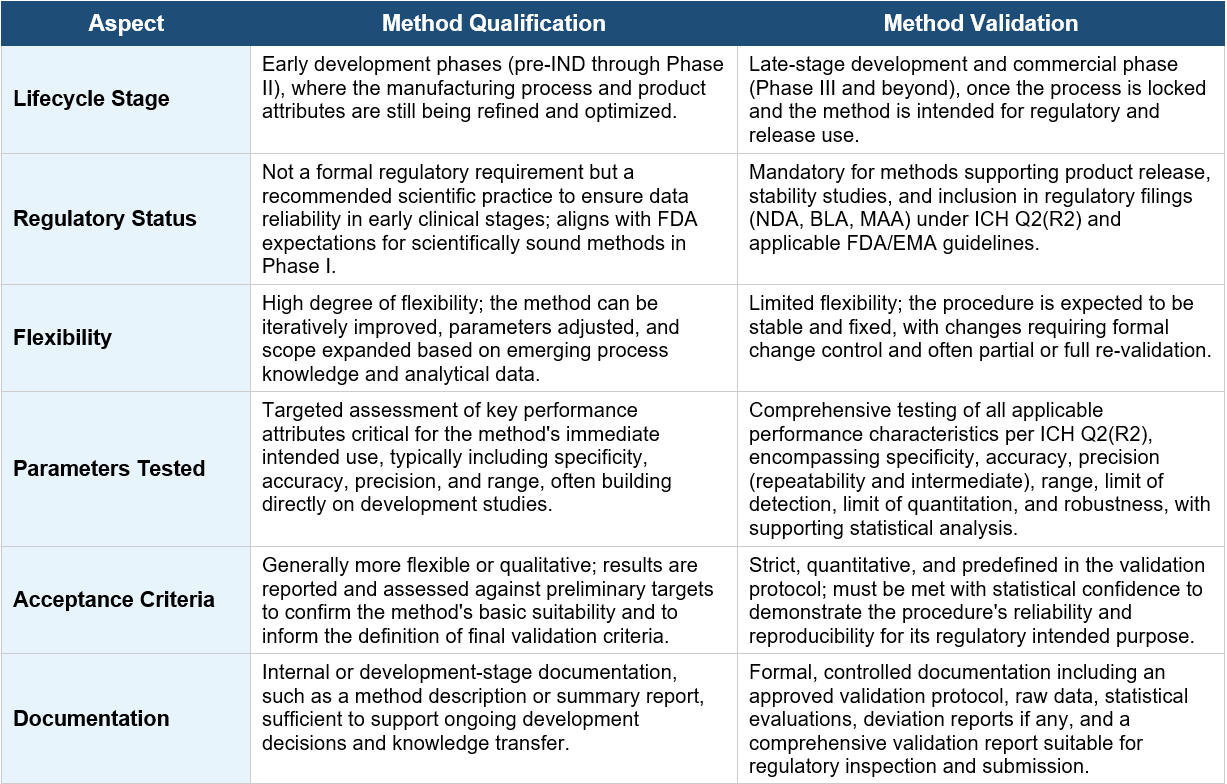
Note: This table reflects current expectations under ICH Q2(R2) and Q14 (adopted November 2023) and FDA guidance for analytical procedures.
Decision Framework
The following process helps determine the appropriate path with clarity:
Is the manufacturing process fixed and the method finalized? If not, perform method qualification using a risk-based selection of parameters.
Will the method be used for GMP release testing, stability programs, or regulatory submissions? If yes, full validation according to ICH Q2(R2) is necessary.
Is the method compendial and being applied to a new product matrix? In this case, verification per USP <1225> is the suitable approach instead of full validation or qualification.
Practical Acceptance Criteria
The following examples illustrate typical industry ranges. All criteria should be justified based on product specifications and risk assessment instead of being applied universally.
HPLC Assay
Specificity requires no interference from placebo, degradation products, or excipients. Linearity should demonstrate a correlation coefficient of at least 0.999 across 70–130% of the target concentration. Accuracy is typically expected in the range of 98.0–102.0% recovery, while repeatability precision should show a relative standard deviation of 2.0% or less based on six injections.
Related Substances and Impurities
Specificity requires a minimum resolution of 1.5 between critical peaks. Linearity from the limit of quantitation to 120% of the specification limit should achieve a correlation coefficient of at least 0.99. Accuracy at the specification limit is generally acceptable within the 80–120% range when justified by risk. Precision at the limit of quantitation typically allows a relative standard deviation of up to 10–15%.
Common Audit Red Flags
Regulatory inspectors are increasingly emphasizing lifecycle management. The following issues frequently lead to findings:
Using validation terminology in early development reports when the method was later changed or when acceptance criteria were not met.
Lack of a clear connection between qualification data and subsequent validation, representing a missed opportunity under ICH Q14.
Generic acceptance criteria copied from other methods without product-specific scientific justification.
Failure to re-evaluate methods after significant process changes or the appearance of new impurity profiles.
Inadequate system suitability documentation and weak links between system suitability and validation acceptance criteria.
Treating qualification as a smaller version of validation rather than a focused, stage-specific checkpoint.
Technology-Specific Considerations
Different analytical technologies face distinct validation challenges and opportunities according to current guidelines.
Chromatographic methods (HPLC, GC, UPLC) usually require full validation. It is essential to perform robustness testing on parameters such as flow rate, temperature, and column age, and this should be addressed during development in accordance with ICH Q14.
Spectroscopic methods (NIR, Raman, FTIR) are often multivariate. Validation should emphasize chemometric model performance, applying technology-specific justifications where allowed by ICH Q2(R2).
Bioassays and potency methods (such as ELISA and cell-based assays) naturally show greater variability. The emphasis should stay on relative potency, parallelism, and proper system suitability. ICH Q2(R2) allows flexibility in this area when supported by scientific justification.
Physical methods (particle size analysis, dissolution) benefit from technology-specific justifications. Particular attention should be paid to dispersion parameters and measurement robustness.
The Business and Regulatory Value of Getting It Right
Correctly distinguishing between qualification and validation is not just a compliance task. It provides measurable business value. Organizations that adopt a structured, lifecycle-based approach usually see faster development timelines because proper qualification greatly reduces validation failures and rework. They also cut overall costs by using development data in validation, as recommended by ICH Q14, avoiding duplicate studies.
From a regulatory perspective, clear lifecycle documentation enables smoother inspections with fewer questions and findings. Well-defined, established conditions and reporting categories also make post-approval changes faster and less risky. Perhaps most importantly, a consistent approach throughout the analytical lifecycle enhances the data integrity culture and reduces errors and deviations.
Looking Ahead: Trends for 2026–2030
Several developments will influence how analytical methods are managed in the coming years. Real-time release testing and continuous manufacturing will require improved method robustness and model-based validation techniques. Multivariate and process analytical technology methods will gain from the flexibility already built into ICH Q2(R2) and Q14, especially regarding model validation and ongoing lifecycle management.
Artificial intelligence and machine learning are starting to appear in method development for robustness screening and data analysis, although this remains an emerging field. Perhaps most importantly, global regulatory harmonization continues to progress, with more agencies aligning with ICH Q2(R2) and Q14. Companies that maintain comprehensive lifecycle documentation will have a clear competitive edge in this environment.
Key Takeaways
Method qualification is adaptable and suitable for early development, whereas method validation is thorough and necessary for late-stage and commercial applications. ICH Q14 should be used to transition development data into validation, minimizing duplication. Acceptance criteria need to be justified based on product risk and specifications, not arbitrarily. The entire analytical lifecycle should be clearly documented, as inspectors specifically seek this connection. Finally, organizations must keep up with technology-specific guidance and emerging fields like real-time release testing and multivariate methods.
In conclusion, treating method qualification and method validation as two related but separate activities within the analytical procedure lifecycle, rather than as interchangeable terms, will save significant time, reduce regulatory risk, and enhance the overall quality and reliability of analytical data from early development through commercial manufacturing. Organizations that understand this distinction will be better positioned to meet current regulatory expectations and adapt to the evolving landscape.
References
• ICH Q2(R2): Validation of Analytical Procedures. Adopted November 2023. https://database.ich.org/sites/default/files/ICH_Q2(R2)_Guideline_2023_1130.pdf
• ICH Q14: Analytical Procedure Development. Adopted November 2023. https://database.ich.org/sites/default/files/ICH_Q14_Guideline_2023_1116.pdf
• U.S. FDA. Analytical Procedures and Methods Validation for Drugs and Biologics. Guidance for Industry (2015, current). https://www.fda.gov/files/drugs/published/Analytical-Procedures-and-Methods-Validation-for-Drugs-and-Biologics.pdf
• United States Pharmacopeia (USP) General Chapter <1225> Validation of Compendial Procedures. https://doi.usp.org/USPNF/USPNF_M99945_04_01.html
• ICH Q2(R2)/Q14 Training Materials (2025) – available on the ICH website. https://www.ich.org/page/quality-guidelines#2-2